Our Systemic Relation to Nature: Restoring a Balance Lost in History
Are you ready to rethink how we relate to the world around us? Together we explore how humans have become the dominant force shaping life on earth, and why our current, often destructive relationship with nature is increasingly unstainable. Together with experts, we examine the roots and consequences of this imbalance and discuss emerging alternatives for living within – rather than outside of – natural systems. Through interactive sessions and a collaborative group assignment, you will develop your own perspective on our connection to nature and gain an introduction to systems thinking as an essential, interdisciplinary approach to today’s main challenges and understand what we need to actually act sustainable.
-
Programme at a glance
Mode of instruction: On-campus (3 weeks) Academic dates: Sunday 19 July - Thursday 6 August 2026 Housing dates: Friday 17 July - Friday 7 August 2026 Academic fees: Student fee:
€1750. Read more about what is included in the fees.
Professional fee:
€2000. Read more about what is included in the fees.
Housing fees: €900 for a private room with private facilities.
Housing is optional. Read more about university-organised accomodation.
Credits: 6 European Credits. Read more about credits and credit transfer. Early admission deadline: Sunday 1 February 2026
Students who require a Schengen Visa to study in the Netherlands are strongly advised to apply before the early deadline to ensure there is enough time to secure a visa appointment before the programme begins.
Regular admission deadline: Sunday 15 March 2026 Who is this programme for? Level: Advanced Bachelor’s students, Master’s students, and working professionals.
Background:
This programme is designed for participants with a strong interest or academic background in the social sciences, environmental studies, sustainability, or related fields such as earth sciences, anthropology, development studies, political ecology, or urban studies.
Students who are eager to deepen their understanding of humanity’s relationship with the natural world, or who wish to explore interdisciplinary perspectives on sustainability and systems thinking, will find this programme especially valuable.
Working professionals—such as those in sustainability consulting, environmental policy, NGO work, corporate responsibility, or nature-focused initiatives—who want to broaden their conceptual foundations or reflect on their professional practice are also warmly encouraged to apply.
This summer programme is ideal for anyone motivated to critically examine contemporary environmental challenges and to explore emerging alternatives for living more harmoniously within natural systems.
-
Programme description
This programme starts from the assumption that fundamental changes in our relationship with the world around us are necessary to address the challenges we collectively face today. The impact humans have on the earth has never been more significant than in the present era. Our influence is now so pervasive that biologists have labelled this period the Anthropocene epoch, signalling that humans have altered the planet to such an extent that we have become the dominant driving force of life on earth.
In our current relationship with the natural world, we often position ourselves outside the very systems we depend on. This disconnect has created a problematic, destructive, and unsustainable dynamics. While change in nature is not new or limited to modern times, the alarming pace at which species are becoming extinct – 100 times higher than baseline scenarios – shows that something is fundamentally out of balance.
In this programme, we explore the foundations of our present relationship with nature. We examine how this relationship can be defined and what the broader consequences are. Throughout the programme, we explore together what characterizes our current stance toward nature and what alternatives might be possible. We also discuss alternatives proposed by organizations, companies, and various contemporary movements.
By the end of the programme, participants will have developed their own perspective on humanity’s relationship with nature and gained a first introduction to systems thinking, understanding that an interdisciplinary approach is essential for sustainability.
-
Academic director
Elfrieke van Galen is one the partners of TheRockGroup, an international sustainability consultancy bureau with offices located in Amsterdam, Brussel, and Cape Town. She has over 20 years of experience, amongst others as Managing Director of KLM City Hopper, KLM’s UK CEO and Senior Vice President of Corporate Social Responsibility and Corporate Communication at KLM and wide range of board memberships. In recent years, she’s been invested in the rights of nature movement and has initiated a variety of programs, courses and projects that critically address our current relation with world around us.
Lucas Steinbusch is one of the sustainability consultants at TheRockGroup. In 2020, he completed his master’s in international development studies at University of Amsterdam with research on sustainable and inclusive capacity development in Amman, Jordan. After this, he worked on migration policy and worked as a project manager for several organizations. In recent years he has been involved with a growing ecosystem that focusses on our relationship with nature and has developed courses aiming to address this issue for the universities.
-
Explore our community
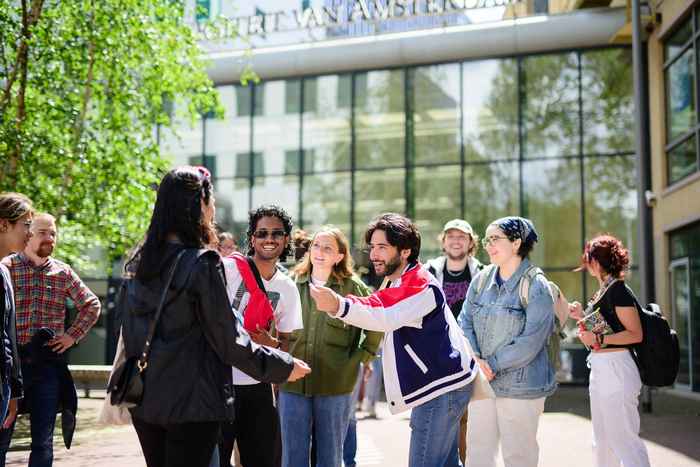
Want to get to know more about studying in Amsterdam? Follow us on social media and join our summer community. Get a feel for our summer school vibe and our academic and social community, and learn about studying with us through the eyes of past summer school students.

- Mode
- Short-term
- Credits
- 6 ECTS, 3 weeks
- Language of instruction
- English
- Starts in
- July